The Grand Banks Story Updated for the 2025 Yachting Market
If you spend any time walking the docks in 2025, you’ll notice something about the boats that draw the longest stares and the most knowing nods: a surprising number are “new-to-you” Grand Banks from the late 1990s and early 2000s, especially the Heritage 36 and 42. These classics hit a sweet spot the modern market can’t resist: commercial-grade construction, an unbelievably comfortable ride, speeds that range from true trawler to swift cruiser, and total cost of ownership that undercuts many newer yachts by six figures (or more).
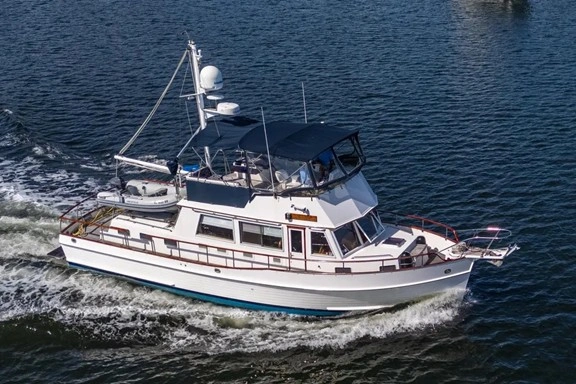
Before we get into the why, let’s set the record straight on the when and how many. The last “known” GB36 production was in 2002 when four boats were built, even though according to Grand Banks’ model history, the last Grand Banks 36 was built in 2004. The last production runs of the 42 (both Classic and Europa) wrapped in 2005, after building 1,555 of these timeless boats. There were over 5,000 boats built over the Grand Banks heritage and predecessors with over 70% of those boats delivered to the East Coast of the USA.
Hulls 1500 to 1555 of the GB42 model are the “Fabulous Fifty”, some of the finest boats ever built by any manufacturer. Oxford Yacht Agency sold and delivered its first new Grand Banks in 1972. The last new Grand Banks sold by OYA (before Grand Banks shifted away from the dealer sales model) was an Eastbay 49, delivered in 2008. This 38-year span brought hundreds of GBs to the East Coast of the US, the majority of those in the Mid-Atlantic.
What follows is the 2025 buyer’s case for the late-model, pre-2005 Grand Banks 36 and 42.
Comfort underway that belies the “trawler” label
If you’ve logged miles aboard a Grand Banks 36 or 42, you know the ride is what wins hearts: soft entry, tracking keel, protected running gear, and a stable, predictable motion that keeps crews fresh. While we still use “trawler” as shorthand, many Grand Banks hulls are semi-planing/planing designs capable of much higher speeds than the word implies. Contemporary testing and brokerage notes for the GB42 show real-world top ends in the 18–21-knot range depending on power, with comfortable cruise set anywhere from 8–16 knots.
That flexibility is one reason the 36 and 42 work so well for American and European cruising styles: loaf along efficiently at 8–10 knots on the ICW or Dutch canals, or pick your weather window and knock out a fast day’s run at mid-teens speeds. Plenty of late 42s, especially Europas, were ordered with bigger engines and have been documented at 20+ knots which is extremely handy when an approaching front moves in and you have to make a run for the marina.
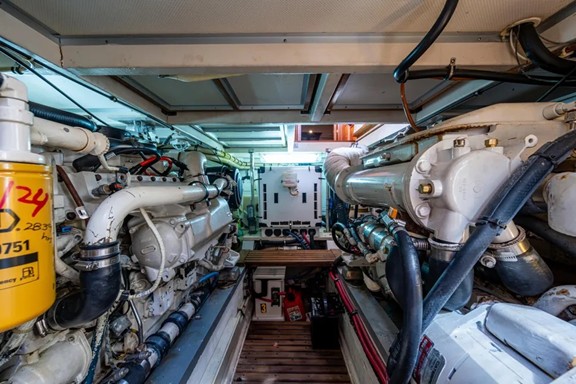
Common engines on these boats were originally the Ford Lehman 120 HP and 135 HP models, followed by John Deere, Caterpillar, Cummins, and Volvos. The average hours on these late model boats is about 4,000 hours, which is extremely low for a well-maintained engine that is seldom run at full throttle.
The “modern systems” you want are already aboard (or easy to add)
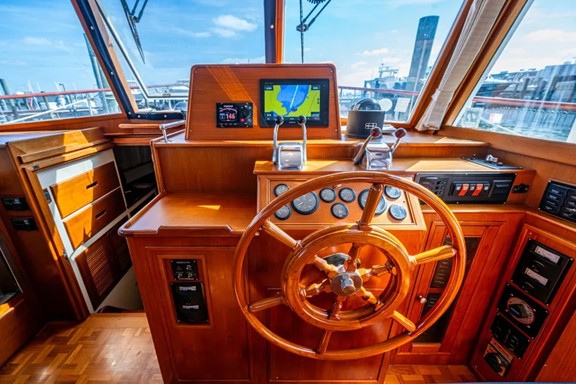
Late-run 36s and 42s often came from the factory with gear that still checks the 2025 boxes: robust AC/DC distribution, inverters/chargers, gensets sized for real hotel loads, bow thrusters, practical tankage, and smart, serviceable plumbing. It’s also common to find premium owner upgrades like stabilizers, modern chargers, lithium batteries, lithium-ready alternators/regulators, and current-generation electronics. That’s partly thanks to specialists who know these boats inside and out and can refresh them to a standard that rivals (or beats) new.
If you’re starting from a more original baseline, the good news is that systems modernization is straightforward on these models: wiring runs are accessible, spaces are generous, and weight can be sited intelligently because the hulls were designed for cruising load. In practice, that means upgrades are cleaner, faster, and more affordable than on some newer, tightly packaged high-tech builds.
Maintenance reduction is real (and attainable)
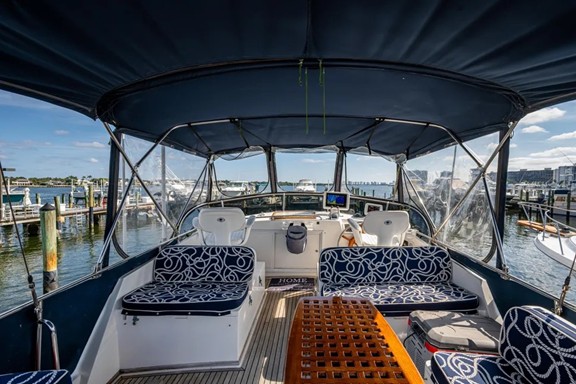
Yes, teak and varnish can be a labor of love, but usually not for the modern boat buyer and they don’t have to be a burden. Experienced Grand Banks yards such as Oxford Yacht Agency have turned “maintenance reduction” into a practical playbook: protect brightwork under cover when possible, schedule sensible service intervals, refinish or replace worn teak methodically, or substitute modern “teak-look” decks when appropriate. The result? You keep the classic look and feel while dramatically shrinking annual elbow grease and cost.
And because these boats were built to be maintained (wide side decks, stout rubrails, through-bolted hardware you can actually reach), routine care is more predictable than on many contemporary yachts. That predictability shows up on the yard bill.Speed range that suits how people actually cruise
One of the best parts of living with a late-model Grand Banks is choosing your pace:
- 8–10 knots: true-trawler efficiency and range for long passages, loops, and lazy summer wandering.
- 12–16 knots: a “fast trawler” groove many 42s excel at, significantly quicker trip times without doubling fuel burn.
- 18–21+ knots: on higher-horsepower boats, when schedule or weather calls for it.
Having that flexibility in a boat with the manners of a displacement cruiser is rare—and a big reason these models have remained some of the most popular designs Grand Banks ever produced.
A quick model primer (what to look for)
Grand Banks 36 (Classic/Europa)
The 36 put Grand Banks on the map and kept evolving until its final year in 2004. Expect cozy accommodations, efficient single or twin diesels, and easy handling in tight quarters. For owners who prioritize range, economy, and classic lines in a compact footprint, it’s hard to beat.
Grand Banks 42 (Classic/Europa/Motoryacht)
The 42 is the “do-anything” sweet spot: two real staterooms, big tankage, and that magical split personality; trawler at 8–10 knots, cruiser at 14–18 knots, with some examples capable of 20+ knots. Final production for the 42 ranges (by variant) through 2005.
When shopping, favor boats with:
- Documented service history on engines, tanks, and running gear.
- Thoughtful electrical upgrades (chargers/inverters, breaker panels, modern nav).
- Addressed exterior woodwork (either protected, refinished correctly, or deliberately minimized for maintenance reduction).
Experienced yards like Oxford Yacht Agency can assess and quote “maintenance reduction” paths that fit how you actually plan to use the boat, from smart varnish strategies to selective deck renewal.
The “2025 Story”: why these boats are more relevant now
The past decade has only sharpened the late-model Grand Banks value story:
- Fuel-price volatility rewards hulls that are legitimately efficient at displacement speeds yet capable of quick passages when needed. The 36/42 recipe stands tall here.
- Electronics have commoditized. The latest MFDs, radars, and communications gear bolt right on; you’re not stuck with yesterday’s technology.
- Supply-chain realities keep new-boat lead times and prices high; clean, modernized classics can be enjoyed now without their steep depreciation curves. Current features and performance from Grand Banks’ latest models only underscore the brand’s ongoing reputation for efficiency and sea-kindliness, which is precisely what these Heritage boats delivered decades earlier.
In essence
For couples and families who want to cruise in comfort, retain speed flexibility, and keep total ownership costs sane, the late-model Grand Banks 36 and 42 remain standouts in 2025. They were built to commercial standards, age gracefully, and, with smart maintenance reduction and targeted modernization, deliver a “new-boat” experience without a seven-figure entry ticket.
If you’re lining up candidate Grand Banks boats to purchase, start with a clear survey, budget for the few big wins that fit your cruising (stabilization, electrical modernization, refreshed canvas/soft goods), and partner with a yard that speaks fluent Grand Banks. Do that, and you’ll understand why these two models are still, decades later, the boats everyone seems to stop and admire.